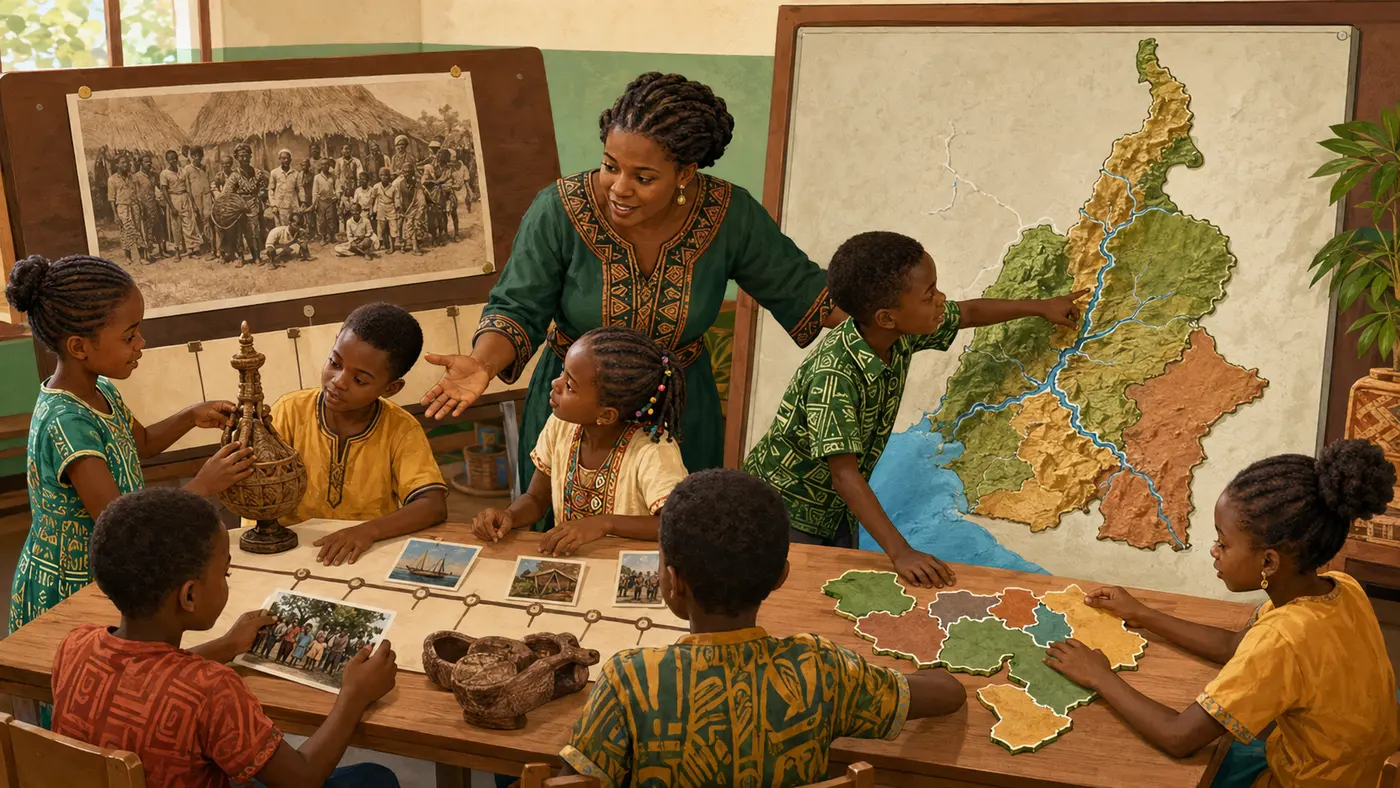
A teacher looking at the broad subject list in the current Cameroon Primary School Curriculum may wonder whether History and Geography have disappeared. They have not. The curriculum introduced for the English subsystem organises learning into broader domains and carrier subjects. Social Studies is the carrier subject for communal life and national integration, and it contains History, Geography and Citizenship. The toolbox should therefore keep the official name Social Studies while still allowing teachers to find each component directly.
The distinction between levels is important. In Level I, covering Classes 1 and 2, the curriculum gives priority to the citizenship component of Social Studies. Children begin with school, family, community rules, responsibilities, living together and other foundations appropriate to their age. In Level II, Classes 3 and 4, History and Geography become visible alongside Citizenship. The same three components continue in Level III, Classes 5 and 6, with wider knowledge, more complex sources and stronger reasoning expected from learners.
This grouping is different from the older approach in which History, Geography, Civics, Human Rights and Moral Education could appear as separate primary subjects. A modern subject list may therefore look shorter even though important content remains. The change is not a reason to merge every lesson into one vague topic. A Social Studies period can have a clear Geography objective about relief or rivers, a History objective about evidence and chronology, or a Citizenship objective about rights, public property and responsible participation.
Geography resources should help children understand location, physical features, climate, vegetation, population, economic activity and the relationship between people and environment. Cameroon provides rich but varied examples: coastal lowlands, the Western Highlands, the Adamawa Plateau, northern plains, major river systems and different rainfall patterns. Teachers should avoid reducing the country to one climate or one landscape. Maps, observations, simple data and comparisons can build geographic thinking rather than asking learners to memorise lists without meaning.
History teaching should introduce chronology, change, continuity, cause, consequence and the use of evidence. Learners can begin with family and local history, oral testimony, photographs, maps, objects and school records. Older primary classes can examine selected national events and compare sources. A date is useful, but History is not only dates. Children should ask who created a source, when it was created, what it claims, why it may have been produced and which other evidence could confirm or challenge the account.
Citizenship connects knowledge with participation and values. Lessons may address school rules, national symbols, public property, peaceful disagreement, human rights, responsibilities, good governance and community life. Citizenship should not become a lecture in which children repeat approved phrases without applying them. Scenario questions, class responsibilities, discussions and small community projects can help learners practise decision-making. The teacher still needs to maintain respect, avoid party-political campaigning and use age-appropriate examples.
For Cameroon Teachers AI, the practical solution is two-layer organisation. The official subject selector remains Social Studies because that matches the curriculum structure. Inside it, teachers can choose History, Geography or Citizenship as a strand. The resource library can also display those strand names as filters so a teacher searching for a History timeline or Geography worksheet does not assume the content is missing. Generated lesson notes and assessments should show both the official subject and the selected component.
Curriculum labels can be updated, and schools may use timetable names that differ slightly. Teachers should check the curriculum document for their subsystem and level, the school scheme of work and current official guidance before planning a sequence. This platform will link to ministry references and will continue expanding its History, Geography and Citizenship sample bank. The purpose is not merely to list every subject. It is to help teachers move from the official structure to accurate, usable classroom materials that children can understand.
← Back to all articles